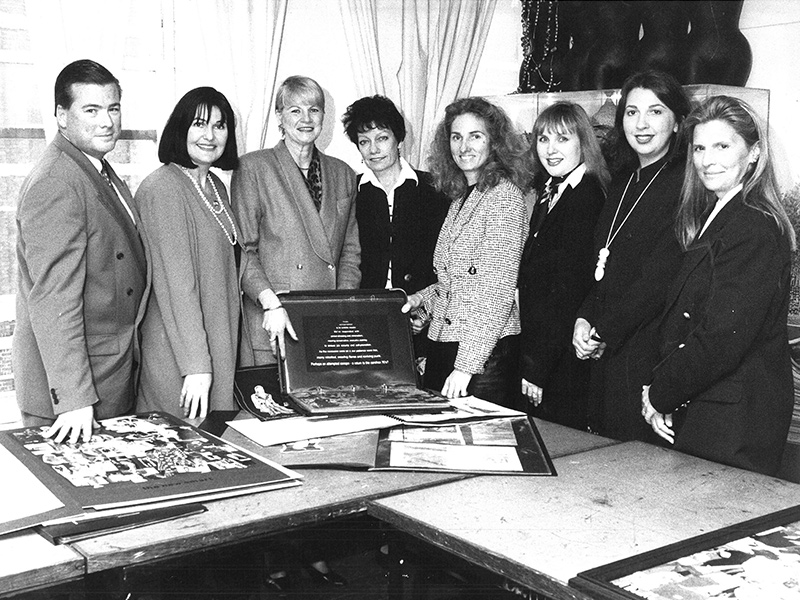

Whitehouse Institute of Design, Australia sees design as positioned at the forefront of rapid and ongoing change in industry, commerce and all aspects of social and community life. In a world of constant flux, education provides a valuable key to innovation, adaptability, personal growth and professional sustainability.
Whitehouse Institute creates and sustains a unique learning environment. This is intentionally designed to induct students into studio practice, working individually, in groups and teams to prepare motivated and reflective practitioners for careers in design and related industries. Courses focus on creative development through drawing, design and fabrication, together with an appreciation of the importance of design history and aesthetics, in addition to enhanced visual, verbal, written and interpersonal communication. Underpinning this is a commitment to collaboration and shared diligence from staff and students in progressively acquiring the essential specialist insights, design skills and knowledge required to work as a professional designer in a range of creative and technical roles in industry.
In August 2011 the Board of Governors approved the following statement for the Whitehouse Institute.
Whitehouse Institute prepares graduates for careers in the creative industries as designers in fashion, styling & creative direction and interior design. Specialised design skills and knowledge are developed through the Institute's teaching and learning programs, and collaborations with commerce, industry and cultural organisations. Graduates will contribute to an equitable and civilised society through their engagement in public programs and experimentation with new materials and sustainable technologies. The Institute fosters a learning culture that values scholarship, critical reflection, creativity, innovation and entrepreneurship enabling graduates to continue learning throughout their lives and contribute to the quality of life and wealth of the economy.
Signed,
Mr Ian Tudor
CEO
Prof. Andrew Gonczi
Chair - Academic Board
Mr Les Taylor
Chair – Board of Governors
Whitehouse Institute Pty Ltd.
The Mail Exchange building has two significant
histories. The early history of the site, prior to the erection of the
building, where Robert Hoddle acquired the land from the Crown and constructed
a two storey Georgian home and gardens and lived in, until his death in 1881. Robert Hoddle was the first Surveyor
General of Victoria and is credited with the physical layout of the streets of
inner Melbourne, these days referred to as “the Hoddle Grid”. Hoddle acquired the land in 1837 after he conducted the first public auction of
crown land in Victoria under instruction from Sir Richard Bourke, the Governor
of New South Wales, the namesake of Bourke Street and the man who named our
city “Melbourne”, after, the British Prime Minister.
The second and more recent
history is the now restored Mail Exchange building and its use by its then
owner, the Post Master General’s Department. The site was acquired from the decedents of
Robert Hoddle at the turn of the Century and construction on the Mail Exchange
Building began in 1913. It was completed
four years later in 1917. Designed by Commonwealth Home Affairs architect John Smith Murdoch (1862 – 1945).
Murdoch was Australia’s first Commonwealth Government architect and went on to
design the Old Parliament House, completed in 1927. Originally built to relieve the congestion at
the nearby Melbourne GPO on the corner of Elizabeth Street and Bourke Street,
it was a conscience effort to modernise the postal system in the early 20th
Century.
Over the years, the building has been known as the Chief Parcels Office, the Parcels Post Building, the Postal Workshops, even for a period (1917 – 1964), as the General Post Office. Subsequently it became the Melbourne Mail Centre and more recently, the Mail Exchange, the signage of which, is still clearly identifiable on both facades. The building was administered by the Post Master General’s Department until 1975, when the Department was separated into Telecom (now Telstra) and Australia Post. When Australia Post vacated the building, it was subsequently acquired in the mid 1980’s as the headquarters for the Figgins Shoe empire. With the eventual relocation of the Figgins Group in 2006, restoration became possible and the building underwent a progressive and significant, internal and external upgrade which welcomed Aconex in 2006, the Whitehouse Institute of Design in 2008, and the brand new Mail Exchange Hotel in 2010.
Please click here to visit the gallery
The Mail Exchange building has two significant histories. The early history of the site, prior to the erection of the building, where Robert Hoddle acquired the land from the Crown and constructed a two storey Georgian home and gardens and lived in, until his death in 1881.
Robert Hoddle was
the first Surveyor General of Victoria and is credited with the physical layout
of the streets of inner Melbourne, these days referred to as “the Hoddle Grid”.
Hoddle acquired the
land in 1837 after he conducted the first public auction of crown land in
Victoria under instruction from Sir Richard Bourke, the Governor of New South
Wales, the namesake of Bourke Street and the man who named our city
“Melbourne”, after, the British Prime Minister.
The second and more recent history is the now restored Mail Exchange building and its use by its then owner, the Post Master General’s Department.
The site was acquired
from the decedents of Robert Hoddle at the turn of the Century and construction
on the Mail Exchange Building began in 1913.
It was completed four years later in 1917.
Designed by Commonwealth Home Affairs architect John Smith Murdoch (1862 – 1945). Murdoch was Australia’s first Commonwealth Government architect and went on to design the Old Parliament House, completed in 1927.
Originally built to relieve the congestion at the nearby Melbourne GPO on the corner of Elizabeth Street and Bourke Street, it was a conscience effort to modernise the postal system in the early 20th Century.
Over the years, the building has been known as the Chief Parcels Office, the Parcels Post Building, the Postal Workshops, even for a period (1917 – 1964), as the General Post Office.
Subsequently it became the Melbourne Mail Centre and more recently, the Mail Exchange, the signage of which, is still clearly identifiable on both facades.
The building was administered by the Post Master General’s Department until 1975, when the Department was separated into Telecom (now Telstra) and Australia Post.
When Australia Post vacated the building, it was subsequently acquired in the mid 1980’s as the headquarters for the Figgins Shoe empire.
With the eventual relocation of the Figgins Group in 2006, restoration became possible and the building underwent a progressive and significant, internal and external upgrade which welcomed Aconex in 2006, the Whitehouse Institute of Design in 2008, and the brand new Mail Exchange Hotel in 2010.